Peer-Reviewed Science · ACI 221.1R · ASTM C1260
The Science of Concrete Failure

CONCRETE
CANCER
EXPLAINED.

Alkali-Silica Reaction is a chemical war happening inside your concrete right now, and it started the day the concrete was poured. Here is what it is, how it works, and why the industry failed to stop it.

6 to 13
MPa of solidification pressure measured as ASR products form in confined conditions (Leemann et al., Cement and Concrete Research 176:107392, 2024)
35%
Compressive strength lost once ASR gel reaches the surface
80%
Relative humidity threshold, above this, ASR becomes active
Once started, it cannot be stopped, only managed
The Canonical Definition

Alkali silica reaction is an internal expansive reaction between reactive silica in the aggregate and alkalis in the cement paste. It is the most serious mechanism of concrete failure, and it is sometimes called concrete cancer.

ASR is a mechanism, not a symptom. Concrete fails. Map cracking, spalling and dimensional movement are what an owner sees on the surface. The reaction is what is producing them. Every term on this page is defined once, as a standalone sentence, in the PSIP definitions, and the wider failure picture is at The Problem.

The Core Mechanism

WHAT IS ACTUALLY
HAPPENING
INSIDE YOUR CONCRETE

Concrete cancer, formally called Alkali-Silica Reaction (ASR), is not a manufacturing defect, a cheap contractor, or bad luck. It is chemistry. Specifically, it is a reaction between two materials that are both inherent to concrete: the alkali hydroxides (sodium and potassium) in Portland cement paste, and the reactive amorphous silica present in many common aggregates.

When water is present, which it always is in pools, driveways, and any structure exposed to weather, these materials react. The result is a reaction product: sodium silicate hydrate. As that product precipitates inside the confined space of a concrete aggregate particle, it generates solidification pressure. The reaction occurs in aqueous pore solution throughout, but the pressure does not come from the product absorbing water.

Peer-Reviewed Mechanism, Cement and Concrete Research 176:107392, 2024

Research using the extended Surface Force Apparatus measured a solidification pressure of 6 to 13 MPa as ASR products precipitate in confined conditions. The authors identify that solidification pressure, and not water absorption by the reaction product, as the mechanism that cracks aggregate particles and expands ASR affected concrete. This is a laboratory model of an aggregate's internal surfaces, not a field measurement.

Source: Leemann, Gora, Lothenbach, Heuberger. "Alkali Silica Reaction in Concrete, Revealing the Expansion Mechanism by Surface Force Measurements." Cement and Concrete Research 176:107392, 2024.
The Three Required Conditions

ASR NEEDS THREE
THINGS. ALL THREE
ARE IN YOUR CONCRETE.

Per ACI 221.1R and the American Concrete Institute's documented research, ASR requires exactly three conditions. The reason this matters is that preventing any one of the three stops the reaction entirely. The reason it is so widespread is that all three exist by default in most concrete mixes, and the industry removed the one additive that was managing this problem.

01
Condition 1, Always Present
Reactive Silica in the Aggregate

Amorphous (non-crystalline) silica is present in most aggregate sources, quartzite, chert, opaline materials, volcanic glasses, and certain types of sand. In Texas, the limestone-based aggregates common in Central Texas contain reactive silica phases. In Tennessee, river sand aggregates can contain reactive quartz. In Florida, silica-rich sands are the dominant aggregate source. The ACI confirms that "almost all concretes will eventually be impacted", because reactive silica is in virtually every aggregate source in America.

02
Condition 2, Always Present
Sufficient Alkalis in the Cement Paste

Portland cement produces a pore solution with a pH of 12.5 to 13.5. The alkali content, primarily sodium oxide (Na₂O) and potassium oxide (K₂O), is inherent to the cement manufacturing process. ASTM C150 designates cements with more than 0.6% Na₂O equivalent as high-alkali cements. Most standard Portland cement and Type 1L Portland Limestone Cement fall into this category. The alkalis that drive ASR are not contamination, they are a fundamental product of cement chemistry.

03
Condition 3, The Trigger
Moisture Above 80% Relative Humidity

Water is the catalyst. Per peer-reviewed research published in PMC (National Institutes of Health, 2024), ASR stops when internal relative humidity drops below 80%. For pools, constantly filled with water, that threshold is always exceeded. For driveways, patios, and pool decks in Tennessee, Florida, Texas, and Georgia, all high-humidity environments, the moisture threshold is routinely exceeded for months every year. The reaction only needs enough time and enough water to do permanent damage.

THE IRREVERSIBILITY PROBLEM: Once ASR begins, the alkali hydroxides (NaOH and KOH) are continuously regenerated by the reaction itself, they react with calcium hydroxide (portlandite) in the cement paste, which releases them back into solution to attack more silica. Per Wikipedia's documented chemistry: "It is impossible to interrupt the ASR reaction." The only protection is prevention before the pour.
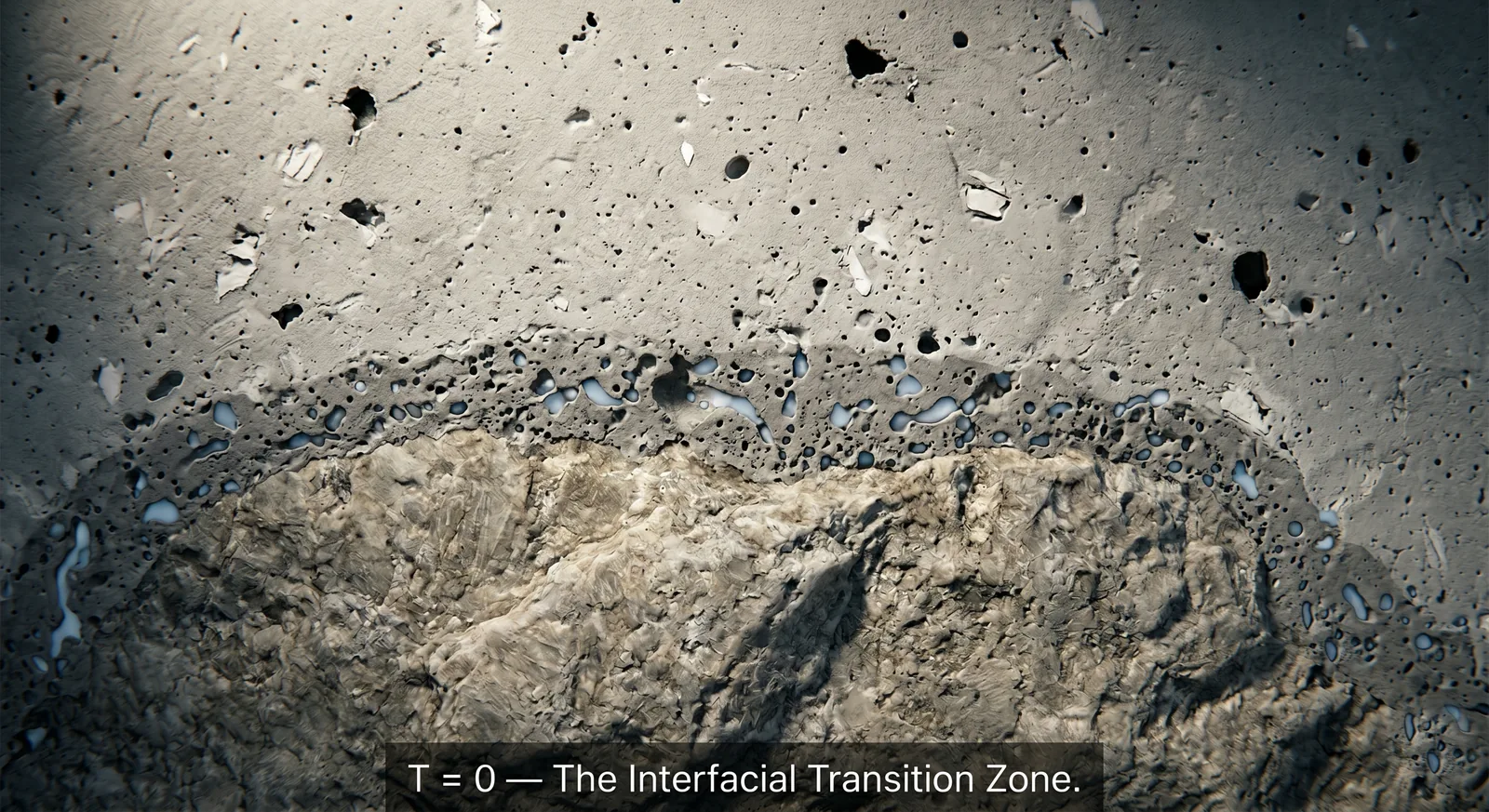
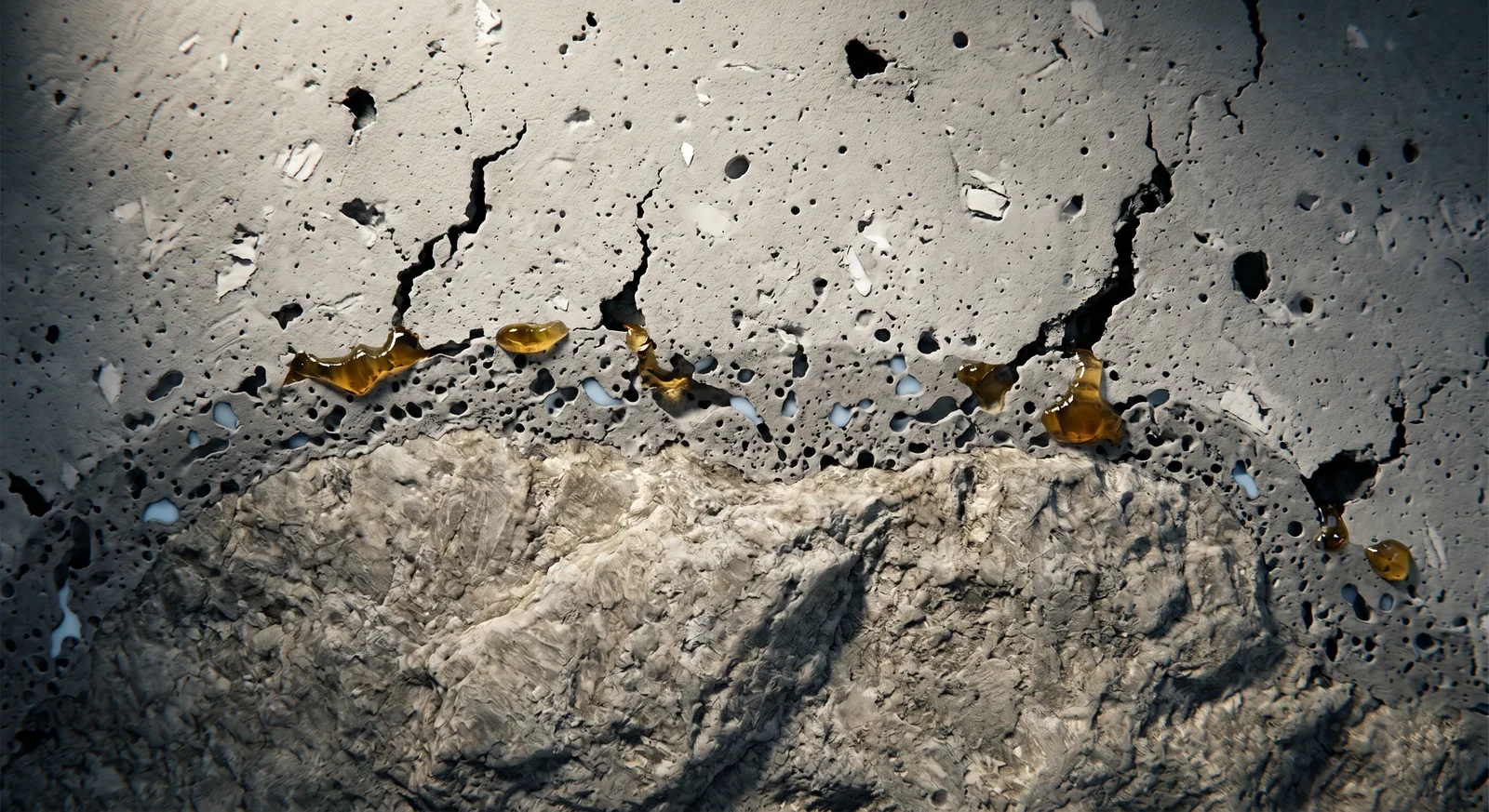
Forensic Visualization · T = 0 The Interfacial Transition Zone
Microscopic view of the interfacial transition zone where alkali-silica reaction initiates. Porous boundary between aggregate at bottom and bulk cement paste at top, with alkali-rich pore water visible as droplets in direct contact with reactive amorphous silica at the aggregate surface.
T = 0. The interfacial transition zone, where ASR begins. The porous boundary between the aggregate (bottom) and the bulk cement paste (top) is where the three required conditions co-locate. Alkali-rich pore water sits in the void network at the aggregate surface, in direct contact with reactive amorphous silica. At this moment no visible surface symptom exists. The reaction has been initiated. The next decades of structural performance are already determined.
PSIP Forensic Visualization · ASR mechanism per Leemann et al., Cement and Concrete Research 176:107392, 2024 · ITZ characterization per Mehta & Monteiro
The ASR Mechanism in Motion

FIVE FRAMES.
CHEMISTRY IN PROGRESS.

Continuing from the interfacial transition zone shown above, the active alkali-silica reaction proceeds through a documented chemical sequence. The reaction proceeds through a documented chemical sequence.

The five frames below visualize each step, from the alkali pore solution filling the open interfacial space, to silica attack, to gel formation, to pressure expansion, to the bond failure that initiates surface-visible cracking. This chemistry proceeds in this exact sequence inside every untreated reactive-aggregate pour from the moment of placement.
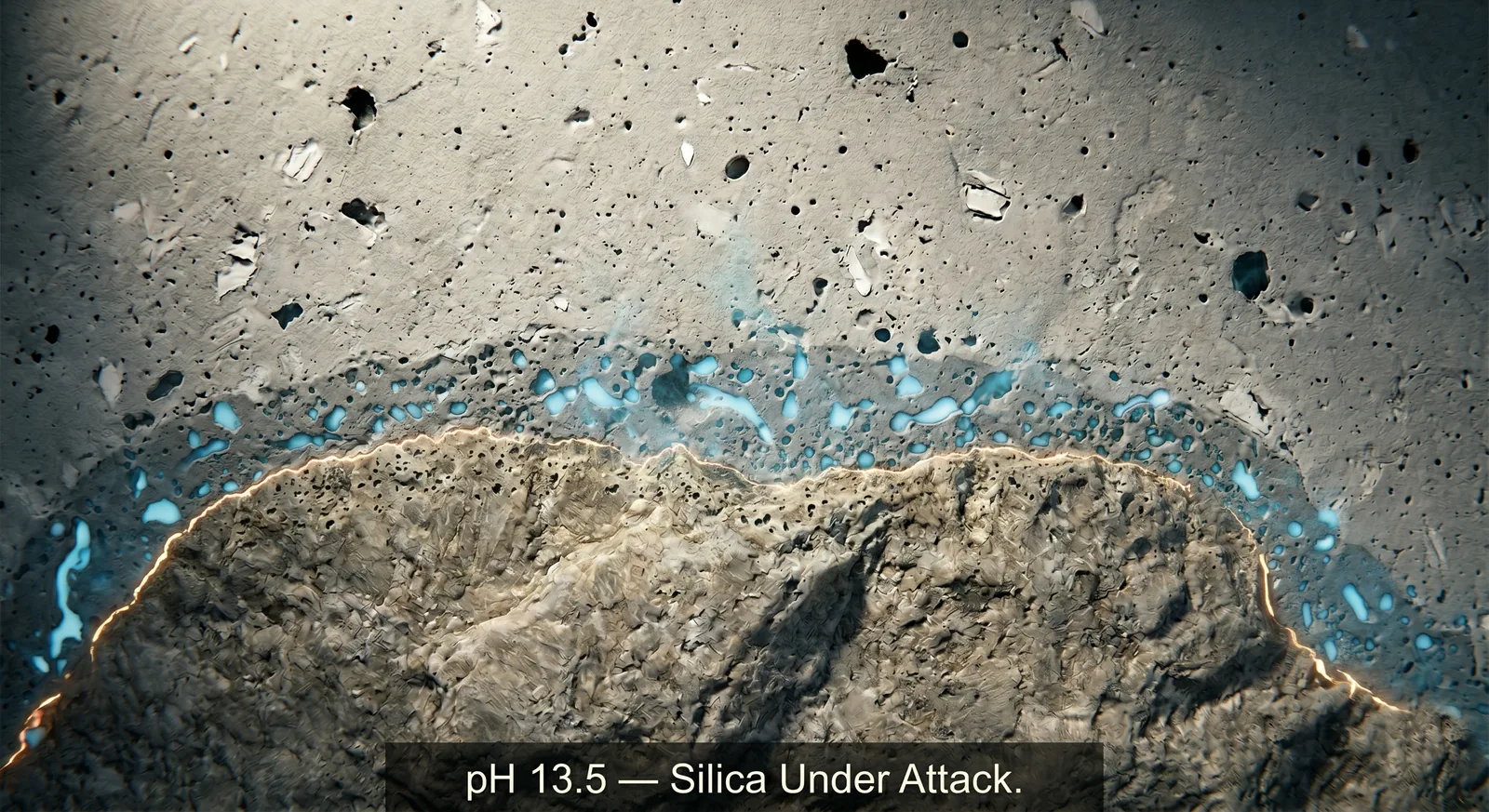
Frame 2 of 6
Microscopic visualization of alkali-silica reaction stage 2. High-pH pore solution containing sodium and potassium hydroxides in the interfacial transition zone in active chemical attack on the reactive amorphous silica at the aggregate surface. The silicon-oxygen bond network breaking down under hydroxyl ion attack.
Silica under attack. The high-pH pore solution that filled the interfacial transition zone now attacks the reactive amorphous silica at the aggregate surface.
Frame 3 of 6
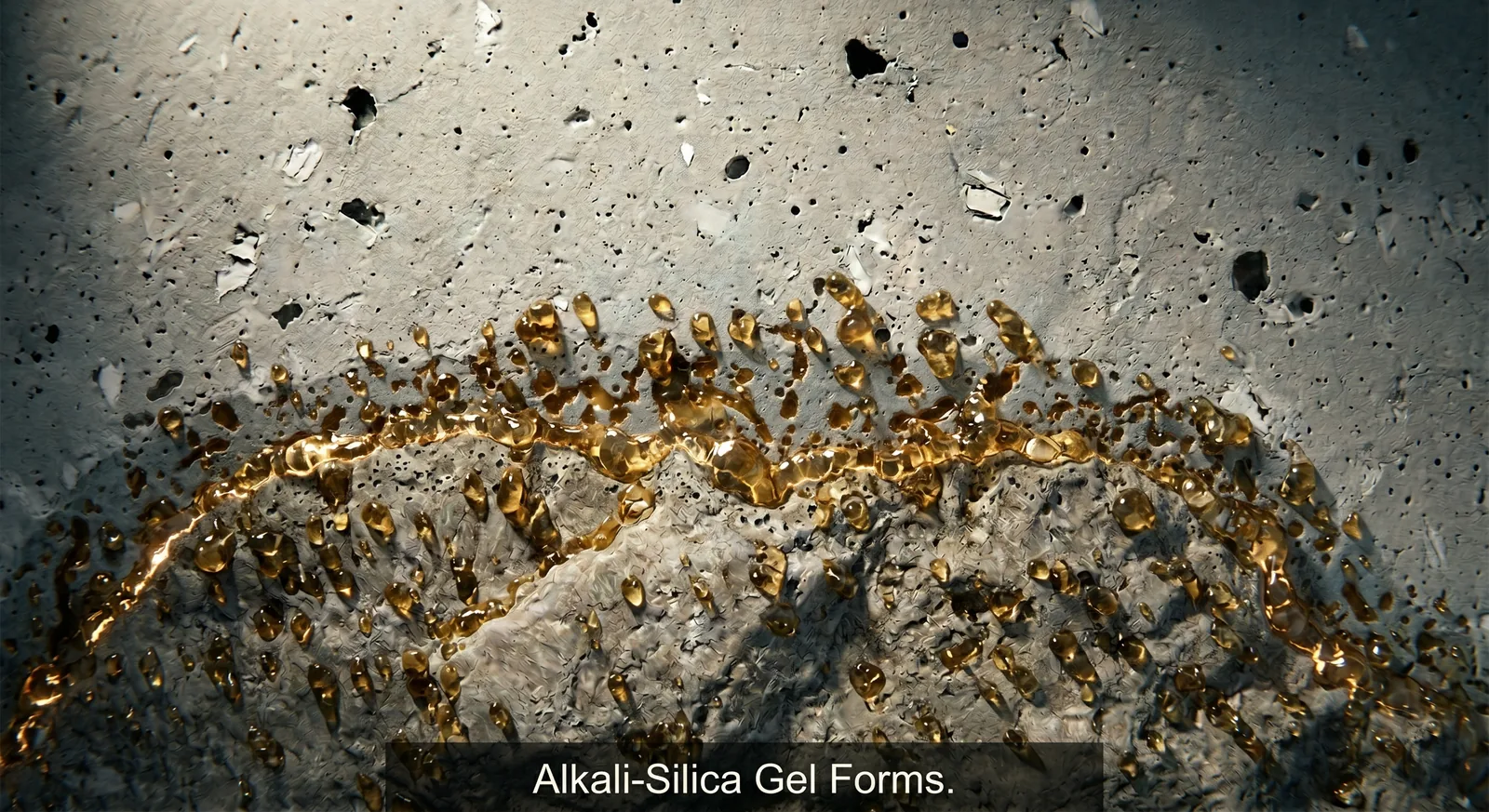
Microscopic visualization of alkali-silica reaction stage 3. Sodium silicate hydrate ASR gel beginning to form at the sites of silica attack on the aggregate surface. The first visible product of the alkali-silica reaction nucleating inside the aggregate matrix at the interfacial zone.
Gel forms. Sodium silicate hydrate (ASR gel) nucleates at the attack sites inside the aggregate.
Frame 4 of 6
Microscopic visualization of alkali-silica reaction stage 4. Continued ASR gel accumulation inside the aggregate. Multiple ASR product pockets now visible, precipitating in the confined space at the interfacial zone. The hygroscopic gel expanding as it absorbs moisture.
More gel accumulates. The reaction continues. Product volume grows in the confined space at the interfacial zone. Solidification pressure builds as more product precipitates.
Frame 5 of 6
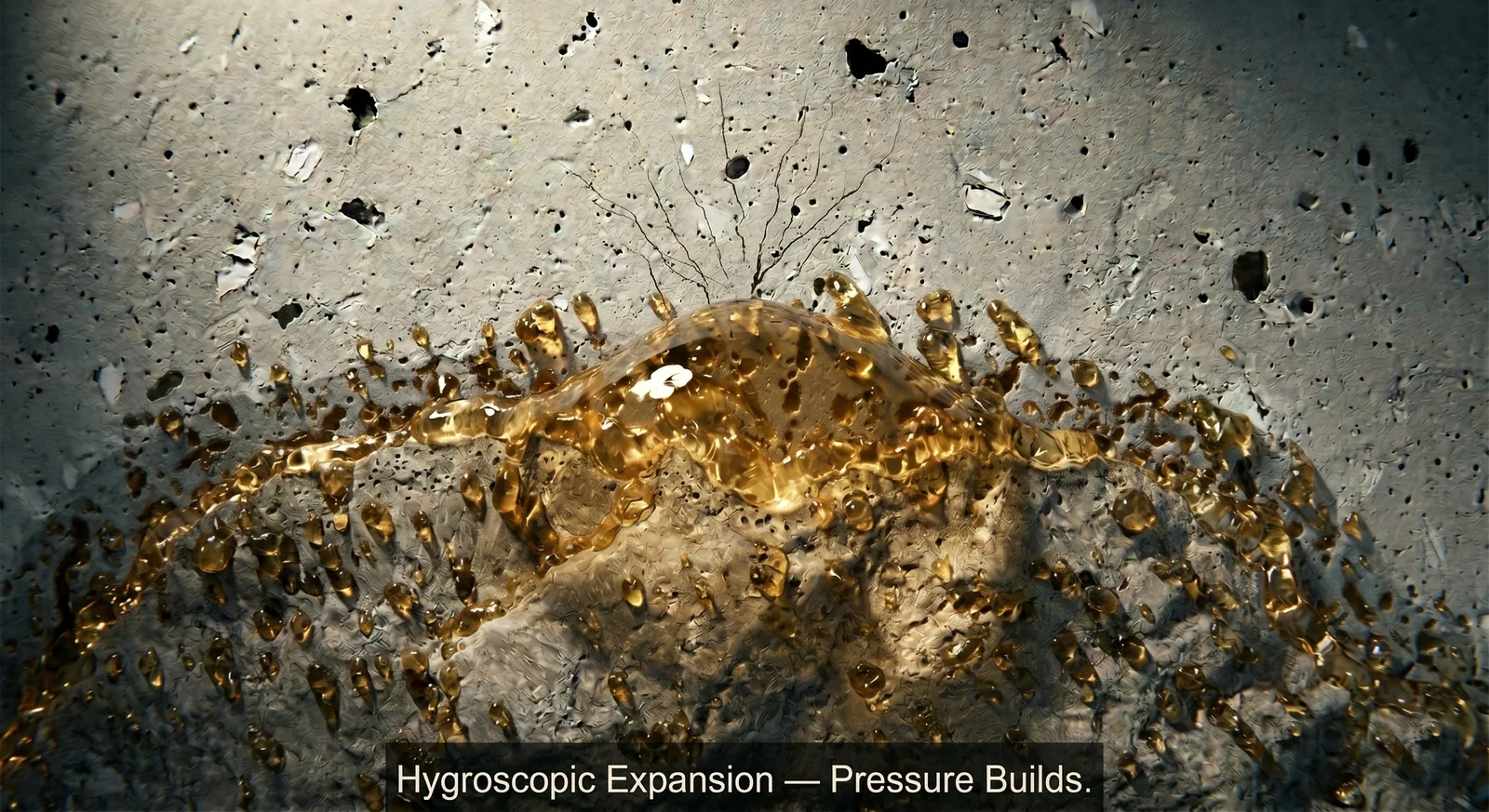
Microscopic visualization of alkali-silica reaction stage 5. Solidification pressure building within the aggregate as ASR products precipitate in confined conditions. Laboratory measurement puts that pressure at 6 to 13 megapascals.
Pressure builds. Solidification pressure builds as ASR products precipitate in the confined space. Laboratory measurement puts that pressure at 6 to 13 MPa and identifies it as the mechanism that cracks the aggregate particle from within.
Mechanism per Leemann, Gora, Lothenbach and Heuberger, Cement and Concrete Research 176:107392 · Reaction sequence per FHWA-HIF-13-019, Alkali-Aggregate Reactivity Facts Book · Visualization sequence produced by Performance Structural Standards Group, Inc., 2026
How to Identify It

WHAT ASR
LOOKS LIKE

ASR produces a distinctive pattern that distinguishes it from other types of concrete cracking. Normal shrinkage cracks follow straight lines along control joints or slab edges. Freeze-thaw damage produces surface scaling. ASR looks different, and once you know what to look for, it is unmistakable.

Symptom 01
Map Cracking

Random, multi-directional cracking that resembles a road map or alligator skin. Unlike shrinkage cracks that follow straight lines, ASR cracks radiate in all directions from aggregate particles. This pattern is caused by expansion occurring simultaneously throughout the concrete matrix rather than at a specific stress concentration point.

Symptom 02
Gel Exudate at Crack Faces

A white, gel-like substance that appears wet or glistening at crack faces. This is the sodium silicate hydrate gel that has expanded beyond the aggregate boundary and pushed through cracks to the surface. In pools, this substance may be washed away by water, but its presence in a core sample confirms ASR definitively. Lab confirmation requires petrographic analysis of 30-micron thin sections under polarized light.

Symptom 03
Surface Expansion + Displacement

Visible lifting or displacement at crack edges, one side of a crack is higher than the other. This occurs because the aggregate expansion is creating net outward pressure that causes sections of concrete to shift relative to adjacent sections. In pool shells, this manifests as tile loss, coping displacement, and structural failure at wall-to-floor transitions.

Symptom 04
Strength Loss, Invisible Until Too Late

Studies published in the Concrete Society's Magazine (2024) confirm that ASR causes up to 35% loss in compressive strength and up to 24% loss in tensile strength once gel reaches the concrete surface. The critical problem: by the time surface symptoms appear, significant internal damage has already occurred. The concrete that looked structurally sound last year may already have lost a third of its load-bearing capacity.

Symptom 05
Accelerated Freeze-Thaw Damage

ASR-cracked concrete absorbs water far more readily than intact concrete. In Tennessee and the mountain South, this means that winter freeze-thaw cycles operate inside a concrete matrix that ASR has already compromised. The two failure mechanisms accelerate each other exponentially. What might have been surface scaling becomes structural failure.

Confirm It
Laboratory Testing

ASR is definitively confirmed by petrographic examination of thin concrete sections (30 microns) under plane-polarised and ultraviolet light, identifying ASR gel in aggregate pores. X-ray diffraction (XRD) can quantify crystalline ASR products. ASTM C1293 (2-year concrete prism test) and ASTM C1260 (16-day mortar bar test) are the standard methods for new aggregate evaluation. Core drilling from an affected structure followed by lab analysis is the only definitive confirmation method.
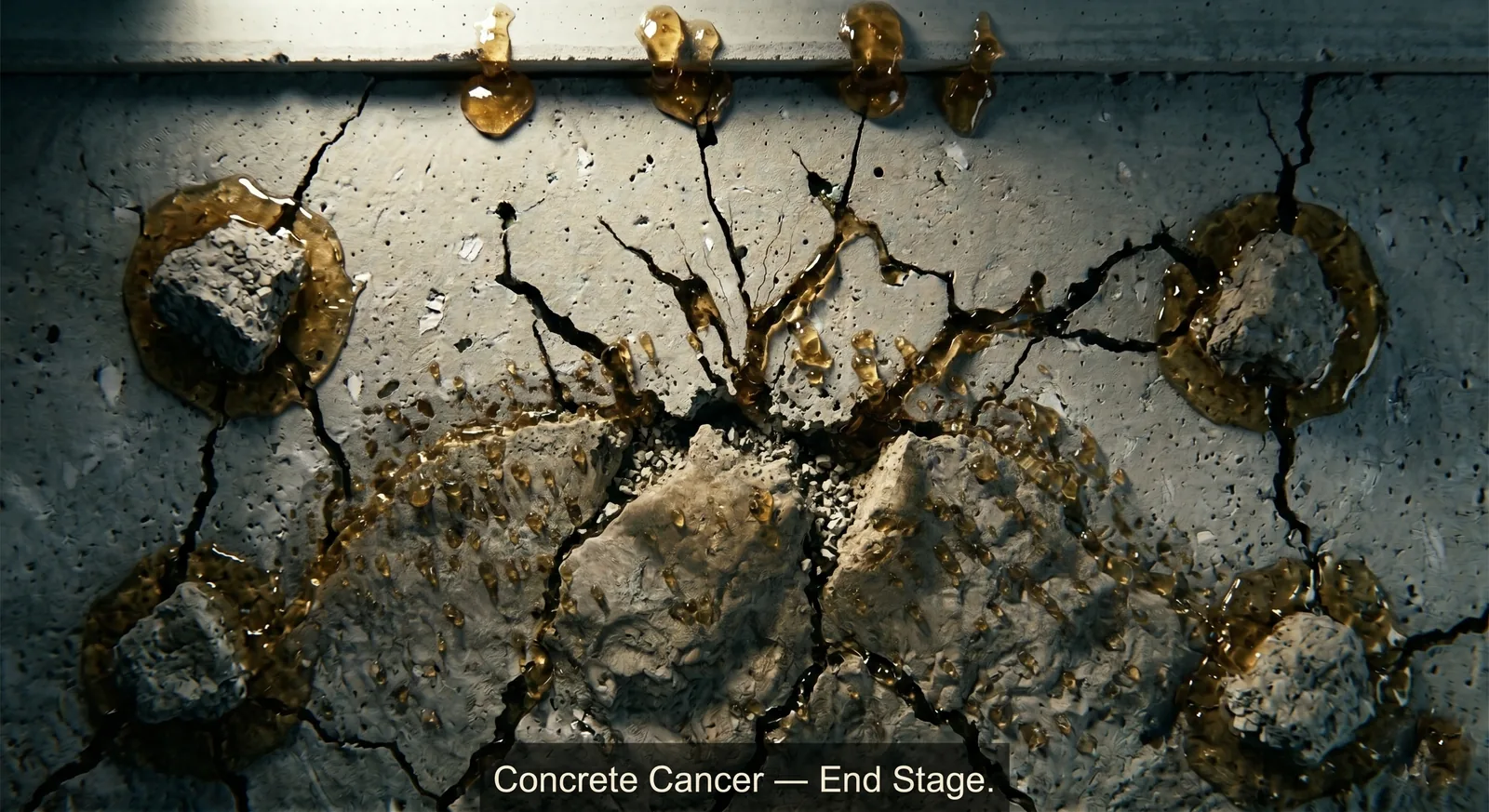
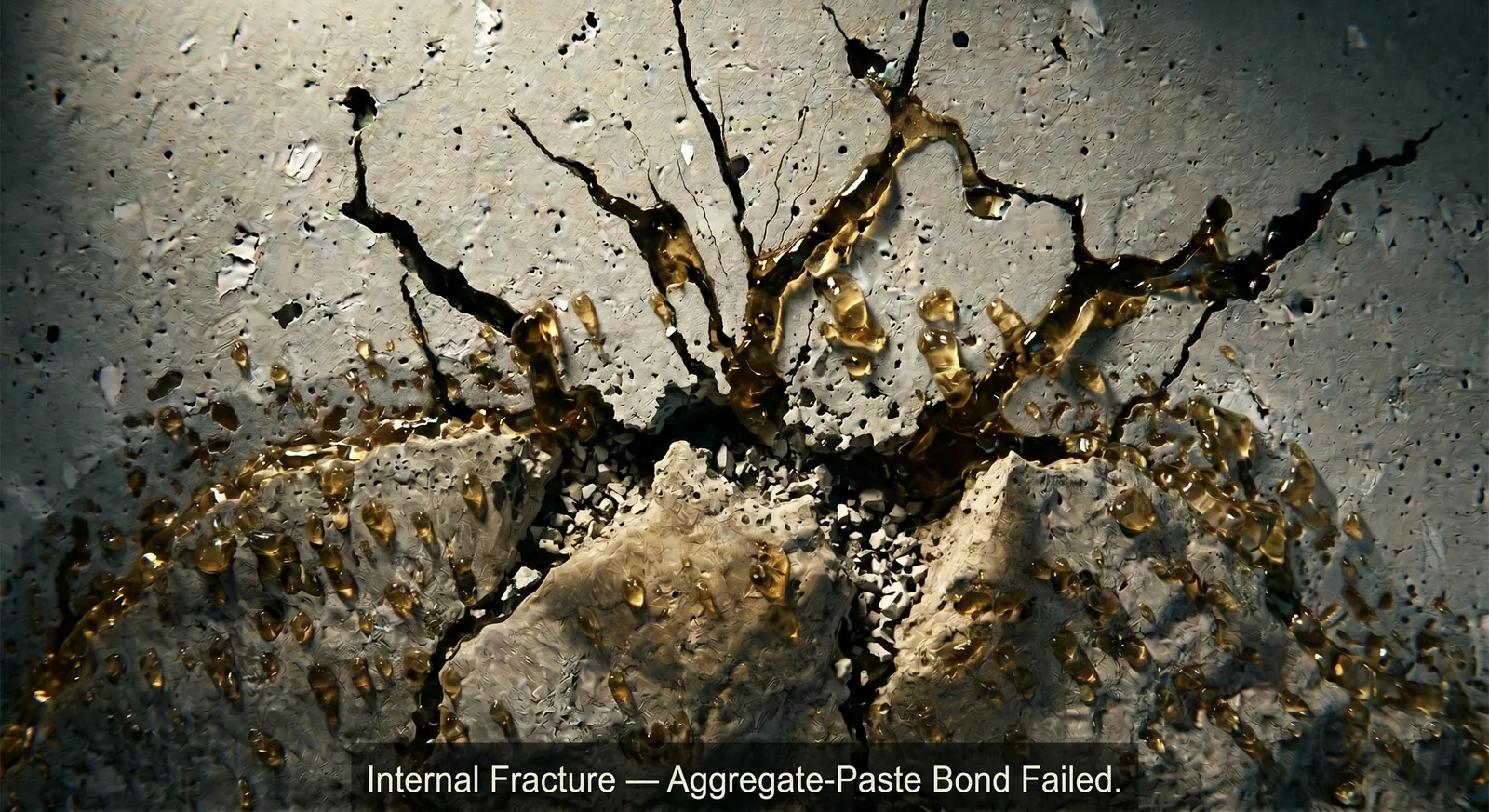
Forensic Visualization · End Stage Concrete Cancer, Surface Signature
Forensic visualization of end-stage alkali-silica reaction damage. ASR gel exudation appearing as amber wet substance weeping from rebar reveal at the top and from radiating crack faces. Map cracking radiating from central aggregate displacement. Pop-out at multiple aggregate boundaries. The composite surface signature visible to homeowners after years of internal ASR progression.
End stage. The six symptoms appear together. ASR gel exudation visible as amber weep at the rebar reveal and at crack faces. Map cracking radiating from a central aggregate. Pop-out at multiple aggregate boundaries. Pressure-driven displacement at crack edges. This is the surface signature after years of internal progression that began at the interfacial transition zone shown above. Concrete that looked sound last year may have already lost a third of its compressive strength.
PSIP Forensic Visualization · Strength-loss data per Concrete Society Magazine 2024 · Lab confirmation per ASTM C295 petrographic analysis
Why It Exploded After 2018

THE FLY ASH
COLLAPSE MADE
ASR INEVITABLE.

ASR has been documented since Thomas Stanton's foundational research in 1940. For eight decades, the industry managed it, primarily through the use of fly ash as a supplementary cementitious material in concrete mixes. Fly ash worked by reducing pore solution alkalinity through pozzolanic reaction, binding the alkalis that drive ASR before they could attack reactive silica. It was not a perfect solution, but it was a working solution.

In 2018, three major Texas coal plants closed simultaneously, removing a critical regional source of Class F fly ash. Concrete suppliers quietly removed fly ash from mix designs. Pool builders, flatwork contractors, and homeowners were never notified. The concrete that arrived on job sites in 2018, 2019, 2020, and 2021 contained the same reactive aggregates and the same alkali-rich cement, but no longer contained the pozzolan that had been managing the reaction for decades.

PUBLISHED IN ASTM: "It is well chronicled that coal fly ash can mitigate the risk of alkali-silica reaction (ASR) in concrete structures." The mechanism: fly ash dilutes pore solution alkalis, consumes calcium hydroxide (portlandite) through pozzolanic reaction, and reduces the availability of alkalis for ASR. Without it, or without a verified alternative, ASR in reactive aggregate environments is not a question of if but when, wherever there is reactive aggregate, moisture, and no mitigation in the mix.

The result was not visible immediately. ASR incubates. The internal cracking begins within months of placement, but surface symptoms typically appear two to four years later in pool shell construction, longer for residential flatwork. The pools built in 2019 started cracking visibly in 2021. The driveways poured in 2020 are cracking now.

The 2018 Texas event was the first regional shock. The pattern has now generalized. 23 coal-fired units at 15 plants stopped burning coal in 2025 alone (EIA). ACAA's 2025 Production and Use Survey documents 14.6 million tons of fly ash consumed in 2024 concrete production, up 2.7 million tons year over year, against a contracting supply base. Multiple major utilities (TVA, Georgia Power, Duke Energy Carolinas) have walked back previously committed coal retirements in 2025 to 2026 under EPA emissions rule rollbacks, preserving regional supply on borrowed regulatory time. The chemistry crisis is not closed. It is rolling, region by region, on timelines that vary by state and by federal regulatory cycle.

Post-Fly Ash Mitigation, The Hierarchy

SCM REPLACEMENT
STRATEGIES THAT WORK.

With traditional fly ash supply declining nationally as coal plants close through 2030, verified alternative SCMs are no longer optional, they are the only documented path to ASR protection. PSIP documents one of the following on certified pours, confirmed on the batch ticket before any material is placed. The hierarchy reflects the locked PSIP doctrine: two parallel Tier 1 categories anchor the protocol, each with a distinct evidence base.

Tier 1A: Natural Pozzolan (Class N per ASTM C618)
Natural Pozzolan, Millennia-Tested Durability

Calcined clay, shale, or volcanic pozzolan at 25 to 30 percent replacement minimum. The chemistry the Roman builders specified for the Pantheon and the Pozzuoli harbor structures, both standing two thousand years later. The chemistry the Bureau of Reclamation specified for Hoover Dam, documented in continuous strength gain over ninety years. Supply-chain-independent. Regionally sourced. PSIP recognizes the work of Joseph E. Thomas in advancing the natural pozzolan standard.

Tier 1B: Colloidal Nano Silica Admixtures
Nano Silica, Modern Lab-Verified Performance

Verified colloidal nano silica admixture, batched at plant. Mechanism: nano silica particles fill micro-voids cement cannot reach, binding alkalis and reducing pore solution pH below ASR activation threshold. Supply-chain-stable modern admixture.

Tier 2, Allowable Where Supply Is Verified
Class F Fly Ash, With Batch Ticket Verification

Minimum 25 to 30 percent replacement by mass of cement. Must be Class F per ASTM C618 (low calcium, high silica), Class C is not equivalent and is less reliable for ASR mitigation. Must be confirmed on the batch ticket with source documentation. Verbal assurance is not accepted under PSIP. Class F has worked historically, but the 2018 Texas supply collapse demonstrated that fly ash availability is not reliable across all regions; natural pozzolan (Tier 1A) is the structurally preferred substitute where regional supply supports it.

Tier 3, Accepted With Verification
Slag Cement / GGBFS

Fifty percent or higher replacement rate required for reliable ASR mitigation. Acceptable under PSIP with batch ticket verification and documented replacement rate. Requires longer cure times and careful cold-weather management.

Not Acceptable as Sole Mitigation
Low-Alkali Cement Alone or No SCM

ASTM C1778 designates low-alkali cement alone as insufficient for reactive aggregate combinations. No SCM at all is the Texas 2018 scenario, zero ASR mitigation. Not accepted under PSIP under any circumstances.

Kinda Like...
SCMs (Supplementary Cementitious Materials)
kinda like a vaccine for your concrete.

When a doctor adds something to a vaccine to make it more effective, an adjuvant, it's not the main ingredient, but it changes what the main ingredient can do. SCMs like natural pozzolan, nano silica, and fly ash work the same way in concrete. They're not the cement. But when they're in the mix, they change how the cement behaves, reducing the chemical activity that causes failure, filling the microscopic pores that let in water, and making the whole matrix denser and more resistant. Take them out and the concrete is exposed. That's exactly what happened to Texas pools after 2018.

Kinda Like...
The Batch Ticket
kinda like the nutrition label on your food.

When you buy a bottle of supplements, the label tells you exactly what's in it, every ingredient, every amount. A concrete batch ticket is the nutrition label for your concrete. It lists the cement type, the PSI strength, the water-cement ratio, and every admixture in the mix. If your contractor can't show you the batch ticket, or if the batch ticket shows fly ash at zero and no alternative SCM, you have no idea what's actually in the structure you just paid for. PSIP-certified contractors verify the batch ticket before a single yard is placed.

You Now Know What Most Contractors Don't

WHAT YOU DO WITH
THIS INFORMATION
DEFINES EVERYTHING.

You just read the peer-reviewed science of concrete cancer. Most contractors doing work in your market today cannot explain what you just learned. That gap is either your problem, or your protection.

For Homeowners + Pool Buyers

QUESTIONS TO ASK
BEFORE YOU SIGN

📋
What SCM is in your shotcrete or concrete mix?If they cannot name the supplementary cementitious material, fly ash, slag, nano silica, and show you the batch ticket confirming it was in the mix, they have no documentation that your concrete has ASR protection. None. "We always use good material" is not an answer. A batch ticket is an answer.
🔬
What is your aggregate source and has it been tested for reactivity?Aggregate reactivity is regional. Reactive silica in Central Texas aggregates is now documented. Florida silica sands are reactive. Tennessee river aggregates can contain reactive quartz. A PSIP-certified contractor has this answer. An uncertified contractor almost certainly does not.
📝
Will I receive a signed workmanship certificate confirming ASR mitigation?The Texas Judicial Panel on Multidistrict Litigation consolidated 100+ ASR lawsuits into a single pretrial court. The central problem in every case: no documentation. A PSIP Aquatic Certificate is the document that confirms, in writing, with batch ticket evidence, that every step to prevent ASR was taken.
A contractor who cannot answer these questions is a contractor who cannot protect you from what you just read.
Find a PSIP Certified Contractor →
For Concrete + Pool Contractors

WHAT YOU'RE CARRYING
RIGHT NOW

⚖️
Every undocumented pool poured since 2018 carries that exposureASR incubates for two to four years in pool shell construction. The pools you poured in 2022 and 2023 without verified SCM documentation are approaching the symptom window. If you don't have batch tickets showing fly ash or nano silica was in the mix, you are answering with memory instead of records when a homeowner calls with spider cracks and gel oozing from their walls.
📊
Homeowners are now educated, and they're asking questionsThe person reading this page is a homeowner or pool buyer who just learned the science of ASR. They are going to call contractors and ask about SCM verification, batch tickets, and documentation. The contractor who says "we always use good concrete" loses that job to the contractor who hands them a PSIP Aquatic Certificate. Which contractor are you?
🛡
PSIP Certified starts at $197/year. One ASR claim can outweigh years of margins.KB Custom Pools filed for bankruptcy under the weight of less than two dozen ASR claims. Cody Pools is fighting its own insurance carriers in federal court (Western District of Texas), in two separate actions involving three of its insurance carriers. The contractors who had PSIP Aquatic documentation, who could show batch tickets, pre-shoot photos, shell thickness measurements, and a signed certificate, had the record to answer with. The others did not.
You now know more about ASR than most contractors in your market. The next decision defines whether that knowledge protects you, or them.
Get PSIP Aquatic Certified Now →
The Only Protection Is Prevention

ASR CANNOT BE
REVERSED.
IT CAN BE PREVENTED.

The science is settled. The chemistry cannot be stopped once it starts. The only defense is verifying that a Tier 1 SCM (Tier 1A natural pozzolan or Tier 1B colloidal nano silica admixture) was in the mix before placement, and documenting it with a signed certificate. PSIP is that documentation system.